
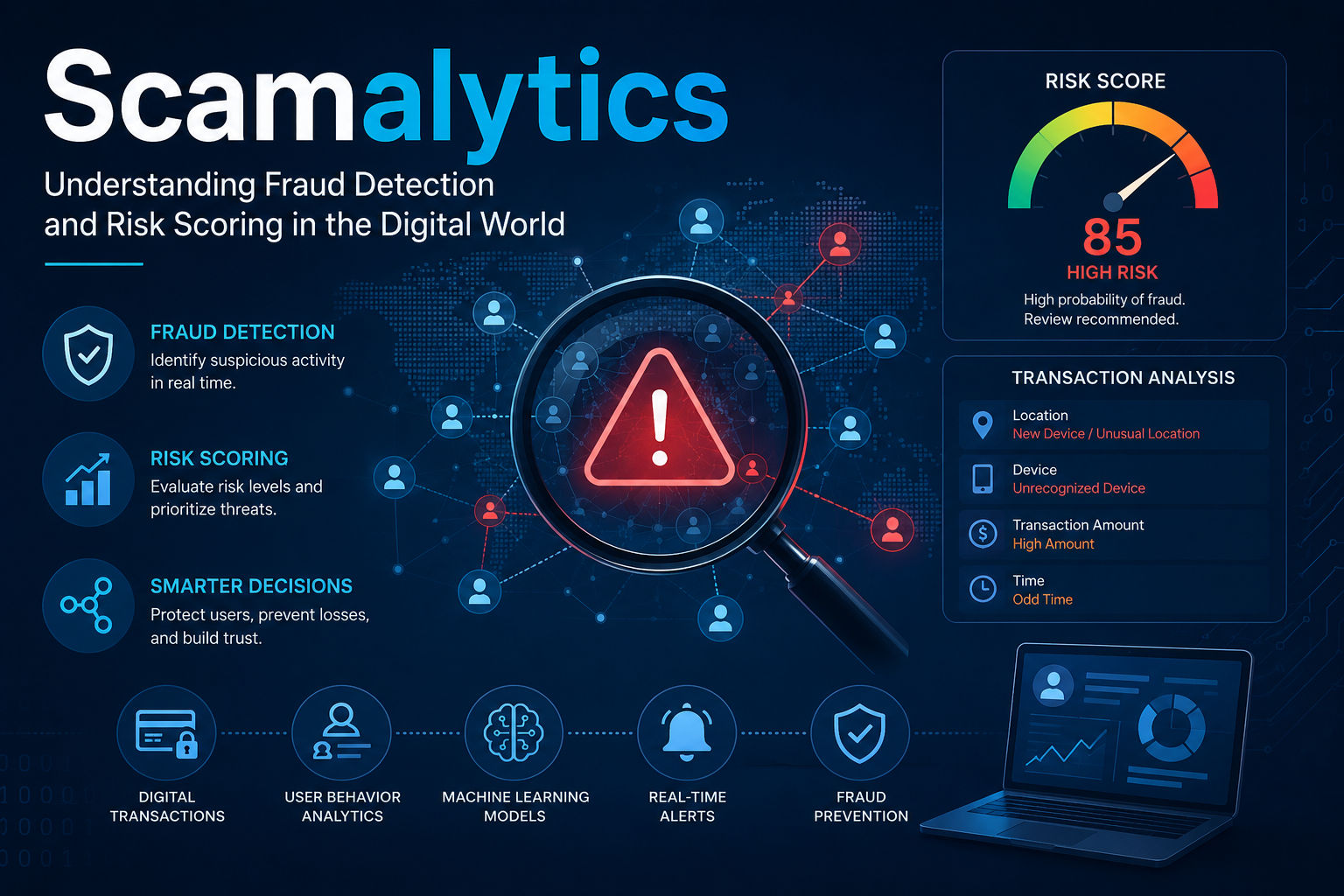
In today’s digital economy, online fraud has become more advanced, more automated, and more damaging than ever before. Businesses of all sizes—especially e-commerce platforms, SaaS companies, dating apps, and fintech services—are constantly under pressure to detect fake users, bots, and malicious traffic before it causes harm. This is where scamalytics plays a major role.
At its core, scamalytics is widely recognized as a fraud detection and risk-scoring system that helps companies evaluate whether a user, IP address, or online behavior is legitimate or suspicious. It works silently in the background, analyzing patterns that humans would never be able to detect at scale. From proxy detection to behavioral analytics, it brings structure to what would otherwise be chaotic digital interactions.
The importance of tools like scamalytics has grown rapidly as cybercrime has evolved. Fraudsters now use VPNs, bots, and fake identities to bypass traditional security systems. As a result, modern businesses rely heavily on automated systems to filter out threats in real time and protect their platforms.
What is Scamalytics and How It Works
Scamalytics is essentially a fraud prevention intelligence system that assigns risk scores to online users based on various signals such as IP reputation, geolocation consistency, proxy usage, and behavioral data. It helps businesses determine whether a visitor is likely to be genuine or potentially harmful.
When a user interacts with a website, scamalytics evaluates multiple data points in milliseconds. These include device fingerprinting, connection type, historical abuse patterns, and network anomalies. The system then produces a risk score that helps businesses decide whether to allow, block, or further verify the user.
Scamalytics is particularly useful because it does not rely on a single metric. Instead, it combines multiple layers of intelligence to form a comprehensive fraud profile. This makes it highly effective against modern cyber threats.
Many cybersecurity experts often describe scamalytics as a “silent guardian of online trust,” because it operates invisibly while protecting businesses from costly fraud attempts.
Importance of Fraud Detection in Online Ecosystems
In the digital world, fraud is not just a risk—it is a constant presence. Businesses lose billions annually due to fake accounts, payment fraud, click fraud, and automated bot attacks. Tools like scamalytics help reduce these losses by filtering out suspicious activity before it can impact systems.
Fraud detection is especially important in industries where user trust is essential. For example, dating platforms need to ensure real users are interacting, while financial platforms must verify identities to prevent money laundering or account takeovers.
Scamalytics strengthens this layer of protection by providing real-time risk evaluation. Without such systems, companies would be forced to manually review every interaction, which is impossible at scale.
As one cybersecurity analyst famously said:
“Trust online is not assumed anymore—it is calculated, scored, and constantly verified.”
That statement perfectly reflects why scamalytics has become a crucial part of modern digital security infrastructure.
Scamalytics Scoring System Explained
The scamalytics scoring system is built around assigning a numerical value to each user or IP address. This score represents the likelihood of fraud or suspicious behavior. The higher the score, the more risk is associated with that entity.
The system considers multiple signals such as VPN usage, hosting provider reputation, spam history, and geolocation inconsistencies. For instance, if a user logs in from a known data center IP or frequently switches locations, the score may increase.
Businesses use these scores to automate decisions. A low score might allow instant access, while a high score could trigger additional verification steps like CAPTCHA or email confirmation.
One of the strengths of scamalytics is its adaptability. It continuously updates its scoring logic based on emerging fraud trends, ensuring that businesses remain protected even as attackers evolve their tactics.
Key Features and Technology Behind Scamalytics
The technology powering scamalytics is based on advanced data analytics, machine learning models, and global IP intelligence databases. It evaluates millions of data points every day to identify patterns associated with fraud.
One of its most powerful features is proxy and VPN detection. Fraudsters often use these tools to hide their real location, but scamalytics can detect anomalies in routing behavior and flag suspicious connections.
Another important feature is behavioral pattern recognition. Instead of relying solely on static data, scamalytics analyzes how users interact with websites, including typing speed, navigation behavior, and session consistency.
It also integrates reputation scoring systems that track IP addresses over time. If an IP has been associated with spam, hacking attempts, or bot activity, it will carry a higher risk profile.
Overall, scamalytics combines multiple technologies into a single intelligence layer that helps businesses make smarter security decisions.
Use Cases of Scamalytics in Real Businesses
Many industries rely on scamalytics to protect their platforms from abuse. E-commerce websites use it to prevent fake orders and payment fraud. Online marketplaces use it to detect fake sellers and bots that manipulate listings.
SaaS companies also benefit from scamalytics by identifying fraudulent sign-ups and preventing trial abuse. Similarly, advertising networks use it to reduce click fraud and ensure genuine engagement metrics.
In the fintech sector, scamalytics plays a vital role in preventing identity fraud and securing transactions. It acts as an additional layer of verification beyond traditional authentication systems.
As digital ecosystems grow, scamalytics continues to become a foundational tool for maintaining trust and integrity across platforms.
Benefits and Limitations of Scamalytics
One of the biggest benefits of scamalytics is its ability to automate fraud detection at scale. Businesses no longer need to manually review suspicious activity, saving time and resources.
It also improves security accuracy by combining multiple signals rather than relying on single-point verification methods. This reduces false positives and ensures legitimate users are not blocked unnecessarily.
However, like any system, scamalytics is not perfect. Sometimes legitimate users using VPNs or shared networks may be flagged incorrectly. This can create friction in user experience if not properly balanced with business rules.
Despite these limitations, scamalytics remains one of the most effective tools for real-time fraud prevention in modern digital environments.
Comparison Table of Scamalytics vs Other Fraud Detection Tools
| Feature | Scamalytics | Traditional IP Filters | Manual Review Systems |
|---|---|---|---|
| Real-time scoring | Yes | Limited | No |
| Proxy detection | Advanced | Basic | No |
| Automation | High | Medium | Low |
| Scalability | Very High | Medium | Low |
| Behavioral analysis | Yes | No | Partial |
| Fraud accuracy | High | Moderate | Variable |
Scamalytics stands out because it integrates automation, behavioral analysis, and global intelligence into a single platform. Unlike traditional systems that rely on static rules, it continuously evolves with new fraud patterns.
This makes scamalytics a preferred choice for businesses that need scalable and intelligent fraud protection solutions.
How to Interpret Risk Scores Effectively
Understanding risk scores is crucial for using scamalytics effectively. A low score generally indicates safe user behavior, while a high score signals potential fraud risk.
Businesses often define their own thresholds based on their industry. For example, a fintech platform may require stricter rules than a blog or content website.
When interpreting scamalytics results, it is important to consider context. A high score does not always mean malicious intent—it could also reflect unusual but legitimate user behavior.
That is why many systems use layered verification methods rather than relying solely on automated blocking.
Best Practices for Reducing Fraud Risk
To maximize the effectiveness of scamalytics, businesses should combine it with other security practices such as multi-factor authentication, email verification, and CAPTCHA systems.
It is also important to regularly review flagged users to ensure that legitimate traffic is not being blocked. Fine-tuning thresholds based on real data helps improve accuracy over time.
Educating users about secure login practices can also reduce the chances of account compromise. Security is most effective when technology and user awareness work together.
Future of Fraud Detection and Scamalytics
The future of fraud detection is moving toward deeper automation and artificial intelligence. Systems like scamalytics will likely become even more predictive, identifying fraud before it happens rather than reacting afterward.
Machine learning models will continue to improve accuracy by analyzing larger datasets and detecting subtle behavioral anomalies. This will help businesses stay ahead of increasingly sophisticated cybercriminals.
As digital ecosystems expand, the role of scamalytics will only grow stronger in maintaining online trust and security.
Conclusion
Fraud prevention has become a critical necessity in the modern internet landscape. With the rise of bots, fake accounts, and automated attacks, businesses need intelligent systems to protect their platforms. Scamalytics provides a powerful solution by combining risk scoring, behavioral analysis, and IP intelligence into a single system.
While no system is perfect, its ability to adapt and evolve makes it one of the most reliable tools in the cybersecurity space. As online threats continue to grow, scamalytics will remain an essential part of digital defense strategies for businesses worldwide.
FAQ Section
H3: What is Scamalytics used for in online security?
Scamalytics is used to detect and prevent online fraud by analyzing user behavior, IP reputation, and network signals to assign risk scores that help businesses identify suspicious activity.
H3: How accurate is Scamalytics in detecting fraud?
Scamalytics is highly accurate because it uses multiple data layers for analysis, but like all systems, it is not perfect and may occasionally flag legitimate users depending on their network behavior.
H3: Can Scamalytics block real users by mistake?
Yes, scamalytics may sometimes flag real users who use VPNs or shared networks, but businesses can adjust settings to reduce false positives and improve user experience.
H3: What industries benefit most from Scamalytics?
Industries like e-commerce, fintech, SaaS, advertising, and online marketplaces benefit the most from scamalytics due to their high exposure to fraud risks.
H3: How does Scamalytics improve fraud prevention strategies?
Scamalytics improves fraud prevention by offering real-time risk scoring, behavioral analysis, and IP intelligence, helping businesses make faster and more informed security decisions.
